Cape Range National Park
We arrived in Exmouth and headed to the tourist information to get further updates on this area and then we headed to the beach for a swim, lunch and of course reading ;-) We decided to camp close to the lighthouse maybe it guides us through the night. Our first excursion took us into the eastern side of the Cape Range NP to the Charles Knife Gorge and the Thomas Carter Lookout as well as to the Shothole Canyon. Unfortunately these areas were not really impressive – the only remarkable thing is how Shothole Canyon got its name; shotholes were left when some companies explored the region hoping to find coal or iron-ore but as there are no mine sites they were not successful.
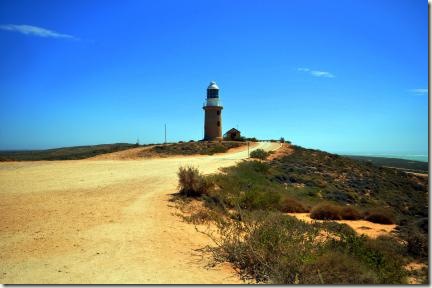
The next day we discovered the beaches; first stop was Bundegi beach where snorkelling is possible. But we didn’t see much. We drove to one  wreck site, the SS Mildura ran aground and sank just 50m offshore. Luckily it’s still possible to see something of the ship but in some years the wooden structure might be completely rotten away. Then it was time to have a look at the northern beaches which offer a break so we were hoping to see a surfer. But no luck so we went on and drove up to the lighthouse. As it was on a hill we had 360degrees views onto the caravan park, the ocean and the inland.
 Now we drove to the Cape Range National Park which covers the western side of that peninsula. It is also the place of the Ningaloo Reef which is sometimes just 50m offshore. This meant we could go snorkelling and
 snorkelling and of course snorkelling. There were so many different beaches to choose from so we had to decide. And the decision was easy; just stay several days so every beach could get its own day!
Yardie Creek was our first stop – this is the furthest camping area in the park. If you want to travel on along the coastline you have to cross the saltwater creek and go for miles through sand and military land before you finally reach Coral Bay. The camp area was just a stone throw from the water  – just go over the dunes and start swimming. We also walked into the Yardie Creek. Actually not into the creek but on top of the cliff with views into the gorge carved by the creek. This area is inhabited by black-footed rock wallabies but we saw one at the Tulki beach area.
 Sandy Bay was on our agenda as well. Actually we really liked that place and returned several times. Sandy Bay is used by several water-sport enthusiast, kite-surfer, swimmer and snorkelers. We watched the kite-surfers for a long time, there were around 10 surfers. It looked like they had a training class or
  surf lesson on. It was interesting to see them preparing their kite, then surfing and what a hassle it can be to get the kite back to the ground. But we got our snorkelling gear out and went into the water. And it was awesome – we saw so many different fishes (species, colour and size). Our first encounter was with a big sting ray. It was laying on the ground and didn’t move. Ok it started to move when I tried to get a close-up. I think the tail was around 2-3m and the body another 1.5m – it was big and still swam away quickly. Then we saw a lot of other fishes, clam shells and corals. But after 15min we had to get out of the water to warm up again.
 On our next trip we saw more and other fishes and once again one you don’t really want to get close to. We saw some white-tipped reef-sharks. But luckily they had their mind on finding a place to sleep and were not hungry. Although they were quite interested in us – they circled around us and came close as 3m. I guess that the one shark was around 3m long and the other 1.5m. One curious thing was that we noticed the shark as all other fishes suddenly swam away. They must have sensed the shark but they returned shortly and found their place to sleep as well.
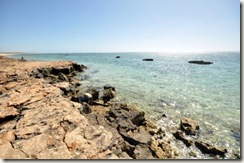 We snorkelled at Oyster Stacks as well. This area was not as nice as Sandy Bay so we only visited it once. Oyster Stacks is an area where oysters grow really close to the beach. Actually you have to climb over them to reach the water so you have to head the warning “only swim at high tide 1.2m or higher”. Otherwise you risk injuries to yourself as well as you can damage the reef. The oysters have such sharp edges it would really hurt if you cut yourself. And I’ve heard that such a wound would heal slowly and might get infected easily. Although we swam at a tide of over 1.2m it felt there was only 5cm between us and the coral.
 At the area Turquoise Bay we had also two opportunities to snorkel – to snorkel in the bay or in the drift snorkel. We opted for the drift snorkel. Should be something different! The current in that area was so strong you really were drifting. The warning here says “only experienced snorkelers should use the area and still be aware of strong currents! also don’t go further than a “special marked” sandbank”. We went in and came out 100m away
  from our entry point but hardly noticed it while in the water. One of the highlights was that we snorkelled with a turtle. It suddenly appeared underneath us, looked at us and swam away fast. It’s unbelievable how quick they move and how elegant it looks. The parking area was also worth noting. They had nice shade covers and some information about the marine park and the animals.
The last area we snorkelled in was called Lakeside which is close to the visitor centre and has a camp area just some meters away. This is probably a reason why this area is so popular – we couldn’t get any spot at that place. But there was enough space to park the car and then we just walked some meters to the best spot to enter the water. Of course we saw corals and fishes but nothing really spectacular.
 Coral Bay was included in our trip as well which is around 200km south of Exmouth on the other end of the Ningaloo Reef. Coral Bay is famous for its marine life. It’s possible to spot Manta Rays all-year and whale-sharks in season. Unfortunately the whale-sharks season was over (it’s only between April to June, after the coral spawning) and the Manta Rays are not seen (or rarely seen) in the bay. The safest way to see a Manta Ray is by going on a cruise but none was scheduled and they are quite expansive. So we just snorkelled in the bay but we were disappointed. The reef looked damaged – not many colours to see and they just looked dead. The bay is also a shark nursery and at the right time of the day you can see them swimming around. This area is on the other side of the bay and normally they don’t venture into the swimming and snorkelling area.
Time to say goodbye to the Ningaloo Reef, hopefully we find further nice snorkelling place along the coast.
Keep safe,
Cheers, Tom and Anja
PS: I’m sorry that you didn’t hear from us for such a long time but we had friends with us and not time to blog. I hope to be on time soon ;-)


