Friday, January 7, 2011

3. – 6. December

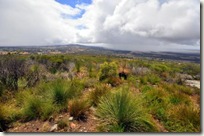
Porongurup National Park and Albany porongurup mountains2 Second start for our tour through the southwest of WA. This time we went via the Albany Highway – hopefully we won’t find any troubles with the van and 4 people ;-)

mt barker lookoutWe camped at a free site close to Mt. Barker. During the night it started to rain and got quite chilly. The tourist information in Mt. Barker is only open from Thursday to Sunday so luckily we arrived on a Saturday and could gather some information. First we went to the lookout on Mt. Barker and enjoyed the vistas in between the showers. We could see all the heavy rain clouds but it didn’t start to rain while we were outside.

tree on the rocks Next stop was the Porongurup National Park and we were hoping for a nice walk with no rain – we had our fingers crossed. There are several hikes so we couldn’t decide which to take… So we just walked to the main attraction – the tree on the rock. It is a funny sight. The tree is really growing out of a rock or on top of a rock. And believe me the tree is tall. We decided to climb the rock (it was only 1m high) to have a closer look at the tree and we saw that the tree is breaking the rock apart. I think some microorganism are responsible that the tree can grow on the rock.

tall taller tree 1 It hasn’t starting to rain yet so we kept walking. While walking we saw more tall trees – mainly Karri, Marri or Tarri trees (I can’t recall 100%). Anyway the trees can grow up to 90m high and reach an age of 400. Such tall trees are also wide – all 4 of us were needed to hug the tree. Some trees even offer some kind of shelter – a fire or some fungus created a hole…

tall tree 2

The walk went uphill and offered several views – in the north to the  Stirling Ranges and in the south to Albany (of course you need clear skies to see). But we could only recognise the coming rain – it looked like the next shower was not far away. But we had luck and it didn’t rain. Unfortunately we had to return the same way as we must have missed one turn-off. Back at the van we had a little coffee and tea break.

porongurup mountains3 Next stop was Albany and we had a look at the region. There are some albany harbour hills and several walking tracks along the coast. First we went to the war  memorial on top of one hill and had nice views of Albany and the harbour. We also saw some bobtails and other lizards – they must have liked the sunshine after two days of rain. And my mum was afraid not to see any wildlife. It’s also possible to track the hill with your  mountain bike – the downhill track was just recentlydinner time finished but we saw no biker. On the other side of the hill was a military museum but we preferred to walk along the beach and coast. Along the coastal walk were several lookouts and some wild flowers to be seen. That evening we enjoyed a pizza at the beach.

Albany’s coast is marked by the Southern Ocean, the bay wild oceanand the river. There are only two places in WA which have a natural sheltered harbour and Albany is one of them. Albany was actually the first settlement in WA but couldn’t not compete with the better (logistic) location of Fremantle and Perth. The coastlines are really different; the bay is relatively calm but not easy to navigate, the river part is good for swimming and the ocean coast is rugged and rough so that some blowholes were formed. Unfortunately they didn’t blow so I’m not able to decide which are better. But we had a look at the natural bridge and they are similar in the south and up north.

flowering banksia

More to come, stay tuned,

Cheers, MaPa, Tom and Anja
mt barker looks porongurup mountains albany natural bridgealbany foreshore 


Sunday, January 2, 2011

29. November – 2. December

Wave Rock and Kalgoorliewave rock 1Finally the road trip had started and we drove east. We planned to reach Hyden that day but unfortunately it came different than planned. The littleplayful parents car broke down and we had to stay in Corrigin and to split our team. Tom had to go back to Perth while I continued with my parents.

So my parents and I had a look at the Wave Rock. The rock was a massive sight although it was much smaller than I anticipated. The wave is 15m high and around 120m long and it looks much much bigger on all postcards. We did the Wave Rock walk wave rock 2which leads underneath the wave and up on the cliff and escarpment. We were wondering how close to the  wave edge it is possible to walk – we saw some kind of fence. We used the stairs to climb up the escarpment and noticed that the fence was really a fence but not to protect people. The purpose was to guide the rainwater into the  catchment dam. There were several sign which explainedhands up high the flora and fauna. We even noticed a little wave rock on top of the escarpment. The Wave Rock contains of granite which did not erode. The other “stones” eroded which exposed the wave. I guess the scientists are not 100% sure why there is actually a wave (the curve on top of it) but I don’t know it any better. There are some further walks but we only drove to one cave to see some aboriginal art.

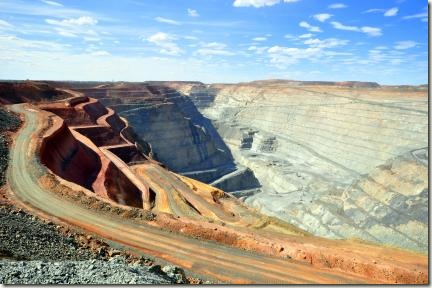
hyden and the localsWe then headed to Kalgoorlie (couldn’t take the direct route as this was gravel road… so we had to take the 150km longer way) but as long as you reach your destination is all ok. We stayed at a free camping spot – first free camping ever for my parents!!! superpit 4Unfortunately we arrived to late in Kalgoorlie to have a look at the  under-ground mine or to witnesssuperpit 5 the blast at 1.00am. But nevertheless we had a look at the Superpit - the open cut mine! And it is massive. We probably looked at it for 1.5h there was so much to recognise and see. The big mining trucks looked like matchbox-cars and needed quite long to exit the pit but were racing back down. We also saw some bagger and cranes which looked tiny but the normal car next to it looked even smaller.

superpit 2 superpit 3  size chartThe lookout is also informative as there are many signs telling you about the mining operation, how it all began, what they do for the environment and which “hardware” they use. One sign is dedicated to the trucks showing how many are in use, how much they weight and costs (purchase price and running costs).superpit 1

Our next stop was at … which was just for 30 minutes or so. The place shows some damaged equipment of the earthquake. You could see the bended railway tracks, the exploded or imploded water pipeline and other pictures of the damage. In the end we arrived in Fremantle again to get Tom onboard and to travel together.

More adventures will come,

Cheers, MaPa, Tom and Anja

21. – 28. November

MaPa has arrived!!!perth skyline We made it in time to arrive in Perth and the first swansthing we did was? No – not checking into a caravan park we drove to the domestic airport and surprised two peoples! My parents arrived for their holiday in Australia. They already spent some time in Darwin before coming to Perth and didn’t expect to see us at the airport. But we were there and greeted them and decided to meet later in Perth city where we had a nice dinner.

bell towerNext day was reserved for the first exploring of Perth. We took one of the three free bus lines and drove to the Bell Tower with the Swan Bells. My parents went up the tower while Tom and I stayed back to take some pictures. While my parents were on the tower the bells started to ring – every day between noon and 1.00pm they ring for a whole hour.


kings parkAfter the first sightseeing accomplished we walked to Kings Park and took the stairs which gave some information of the  Kokoda trail (the famous war hike in Papua New Guinea. We kept on walking through the Botanical Gardens and had our lunch at the War Memorial enjoying the views of the Swan River and got entertained by a group of students…

fisherman 1The next adventure took us to Fremantle. Unfortunately there was no big vessel (neither roro, container or bulk carrier) in the harbour so we went straight to the fishing harbour. We walked along the shoreline to the Round House before saying “hello” to the Fremantle Fisherman. The next day my parents left Perth for a 4-day trip to Shark Bay via Geraldton and Kalbarri.


fisherman 2When they returned we met at the Britz Camper Van Rental Store to pick-up their accommodation for the coming 4 weeks and drove to theround house caravan  park in Fremantle. We tested all things in the van and decided that they would sleep ok in the bed they have to make every day. Then we  changed into our swimming gear and walked to the beach (just 700m away) and jumped straight into the waves.

We decided to stay one more day in Fremantle to give my parents a day rest and to explore more sights – the visit of the Fremantle Prison was  our plan. The Fremantle Prisonfreo prison is a tourist attraction since 1992 – just one year after its decommission. The prison was built (in 1850) by the first convicts of the Swan River Colony. They had to built their own home. It was later used as a prison and served for 136 years – in the end even as a maximum security prison. They hardly changed anything in the prison – no air-con installed or bigger cells. The electricity was installed quite late (if I remember correctly at around 1975). They offer some guided tours; Doing Time, Great Escapes,exercise yard Tunnels and Torchlight tours. The great escapes tour provides an insight about the attempted escapes (not sure how many were successful), for the tunnels tour you have to get underground and change into overalls. You even have to paddle your kayak 20m underground – the tunnels were constructed in 1894 to sustain the water supply for Fremantle. The torchlight tour runs only on Friday and Wednesday nights; you probably hear stories about the loneliness, pain and suffering maintain orderof the inmates including the 45 people who were hanged. Don’t try it if you’re faint hearted.  We opted for the doing time tour. Although the tour was in English my parents enjoyed it (Tom and I did our best to translate) – the guide even used his hands and other signs for his explanations. We had a look at the entrance and received the information  that the prisoner had to change clothes and stand naked before the officers and only one shower per week was allowed. The nextprison gallows stop were the cells itself and what the morning routine was like. The cells are really small not to call them tiny. We also saw the exercise yard and the little hut for the guard. During the prison time some people were on death roll and executed. We saw the cells for their last days and even the death chamber where they were hanged. There is also a church in the prison which is still used as a real church. Our guide mentioned that people got married and used the exercise yard as reception. What a weird place but it should be a life-long sentence… lol

night harbour 

Good bye,

Cheers, MaPa, Tom and Anja

Thursday, December 30, 2010

16. – 20. November

stockyard gully cave We drove south continuing on the Indian Ocean Drive and our first stop  was the Stockyard Gully Nationalstockyard gully cowboy Park. This National Park consist of some caves and lays on an old stock route. The caves were used as an overnight stop as there was water and shade. Although it was completely dry when we arrived so we could explore the cave which was nearly 300m long and had some bends in it. Of course was it  completely dark and we didn’t not forget to bring our torch. bee hiveUnfortunately you can’t enter all caves some are blocked and we found several warning sign – no not concerning the caves – it was about the bees. European bees have built their hives up on the roof and they can sting and they harm the native flowers as they damage something getting the nectar.

The Pinnacle Desert within the Nambung National Park was the next stop.  The 3m high limestone pillars are called Pinnacles. Npinnaclesobody knows how many pinnacles exist as they are covered with sand and get exposed with time and most likely will be covered with sand at one time. There are two possibilities to discover the pinnacles – 1.5km loop walk or 5km loop drive (one way only). We opted for the walk first and had a look at the Pinnacle lookout as well as the Desert lookout. And then we drove around but didn’t see much new or more interesting. We had our lunch break at the Stromatolites in Cervantes which are cousins from Hamelin Pool.

sandy cape sunsetyWe stayed for some nights at the Sandy Cape sandy cape beachRecreation Park, nice camp area directly at the beach. We shared our dinner with the local dolphins – no we didn’t feed them we just watched them. We had the feeling they were listening to our “Flipper-call” every afternoon. A see-lion colony should live close to the bay but they were hiding all day and night.

sandy cape rocks

gingin cable and tower The Gravity Centre in Gingin was our next stop although we stopped several times on the way – had to have a look at the beaches and decide swim in the ocean or in the river. Finally we reached the Gravity Centre and wanted to learn more about Einstein’s theories. We watched the different pendulum in the garden but we couldn’t start them. There was a windpipe which made sounds similar to the ocean swell. I liked the wave cable which was nearly 100m long and you had to hit it hard and wait for its reaction – better to move a bit away. The wave created by your hit bounced back and the swing was even bigger. But the main attraction was the Leaning Tower (in resemblance ofgingin leaning tower down the tower of Pisa). We purchased some water bombs and carried them all the 222 steps to the top of the tower and then let them fall. This experiment should demonstrate if heavier items fall quicker and if they land all at the same spot. But it was hard to see… Inside were some display about Eddy-waves, the influence of magnets and about the start of the universe.

Until next time,

Cheers, Tom and Anja

11. – 15. November

Kalbarri National Park

kalbarri natures window 2 kalbarri natures window 1 We kept exploring National Parks – next stop was the Kalbarri National Park with the river and coastal gorges. The river gorges were created by the Murchison River and some formations are fabulous. We stopped at the Nature’s Window – it definite looks like a window kalbarri zbendwith views – just imagine to open the louvers and inhale the fresh and  brisk air. We didn’t walk the 8km which followed the river looping around the rocks.

kalbarri zbend 2

At the place called Z-Bend the river carved its bed in a Z. It was possible to see the  complete Z from the lookout. And it was build directly at the edge of the cliff. Just look 150m down (nearly vertical) and you could see the ground.

kalbarri np 1 The coastal gorge is the complete coastal region, nearly 13km long. There are several lookouts which offer different views of the cliff and the coast. We stopped at Red Bluff and Blue Holes. The little rock pools are called Blue Holes but it was low tide so not deep enough to go swimming or snorkelling.

kalbarri np coastline We stopped a bit longer at the Island Rock/ Natural Bridge as the formation looked good and we found something in the ocean. kalbarri np natural bridgeThe Natural Bridge is covering a gab of probably 10m and I guess that in several  years (it might take 200) the bridge is not anymore but you find another Island Rock instead. Most likely you’ll find a new natural bridge some meters away. But now to the thing we found in the ocean. At the Eagle Gorge I noticed a wave which could not have been a wave – it just didn’t look like one. But I just saw it once until we reached the Natural Bridge. There the wave was demonstrating the natural beauty of a jumping whale. He was quite active, jumping and showing his tail. I don’t know why he was still so far north so I hope he made it safe back his summer grounds. We also saw some dolphins swimming around the cliff.

 pink lake 2 Before we reached Geraldton we stopped in Port Gregory to look at the Pink Lake. Believe me it’s not an illusion – the lake is pink. The brochure says that Beta Carotene is responsible for the colour – it should react with the water and it turns pink! And I always thought beta carotene would be orange. I’ve heard before that under certain circumstances salt-lakes look pink but I never knew what the reason was.

We decided to stay a little bit longer in Geraldton as the Berliner Philharmonic Orchestra is giving a concert in Perth and it will broadcasted in some regional theatres. We read about the concert in Broome but couldn’t work out which the other cities were but sometimes we get lucky. We arrived on time and they still had tickets available (they were for free) and we enjoyed for 2h nice music.

geraldton sunflare The memorial for the HMAS Sydney II, which was sunk by the German vessel Kormoran, is worth a visit. The wrecks of these vessel were foundhmas sydneyii memorial mummy in 2008 probably 150km west of Shark Bay. The most interesting part is that no crew-member (645) of the HMAS Sydney II survived but 3/4 of the German crew. Unfortunately the memorial is only for the HMAS Sydney crew, they don’t mention the German crew although it is not 100% certain which ship sank which. We also went into the art gallery batavia replica which showed several pictures of isolated areas in Australia (we recognised some of them). The WA Maritime Museum was interesting it provided lots of information about the “ostindische-hollaendische Handeslgesellschaft” which sailed the coast of Geraldton in 1600. Several of the boats actually sank – this coastline has also a nickname “keep your eyes open!”

Bye, Bye

Tom and Anja

hmas sydneyii memorial hmas sydneyii memorial birds