Wednesday, January 12, 2011

10. – 11. December

Climb the tree!!!gloucester viewWe reached Pemberton – another point of the “to-do-list” of my mum or better said something Tom and I had to do… But first things first!

We left the van at the park and decided to use our feets and get driven around – no not in a 4WD but in a tram! The forests around Pemberton were logged and the wood had to be transported… so there was a railwayon the move connection to Bunbury/ Perth. But later the trucks were more efficient to transport the logs and the logging was banned anyway so the railway got dis-used but not dismantled. The part between Pemberton and Northcliffe is used as a tourist railway. It’s a 100 minute return journey (just halfway between Pemberton and Northcliffe). The trip meanders through Karri, Marri and Jarrah forests crossing 6 bridges. During the trip we alighted at the Cascades (not accessible otherwise) and the Warren River Bridge. It was really great and the tram driver explained lots. We single man hut learnt stuff about the history of the town (the oldest houses belonged to the single and married mill workers), the building of the railway (mainly by prisoner and only on elevated ground), the Saw Mill (for a long time the mulch was just a waste product and burnt off – the fire kept burning for 5 years after they discovered the use for mulch), the tram itself (unused trams from Fremantle) and of course about the nature. We hardly saw any water in the streams and brooks and no wildflower was low water seen at all. The driver explained that they had a very dry year – the last big rainfall was in September 2009 (continuously for 21 days) which has flooded the railway tracks and then no rain until June 2010 and just little rain since. We also learnt that the forests are referred as “old-growth” or “re-growth”. Unfortunately there are not many old growth forests left (not a single tree got logged so the canopy is on different levels and it is checked before declared). Most forests were planted between 1925 and 1935 so their canopy is at one level nearly as someone is cutting it. But this doesn’t mean that these tree are not tall – the trees grow in height first before in width. warren river bridge

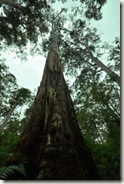
As you can imagine the fire danger is immanent. Today fire planed aregloucester tree used for fire spotting but some years back you had to use manned-fire towers. These trees grow up to 70-80m so it would have been a great  effort to build towers that tall. They came up with another idea and used the trees instead. Some kind of ladder system is built around the trees and it’s possible to climb some – the Gloucester tree (63m), the Dane Evans Tree (75m) and the Diamond Tree (59m). My mum’s plan was to see Tom and myself climbing these trees and we were happy to comply as we didn’t have to stay for long up there. The shift for a fire-spotter was around 4h and if he or she spotted a fire they had to radio it to the nearest station with the best possible location. The gloucester tree closeupjob was nothing for people afraid of height or who can’t endure solitude…

So we walked to the Gloucester Tree and waited until a party reached the  ground. Amazingly there was no official person around to take an entry fee or to supervise. The tree looked quite funny – the ladder spokes were connected like branches and some kind of mesh-protection around. But anyway we started the climb – keeping the advice “don’t lookclimbing anja down” in mind. And up it went – around the tree. The spokes were spread apart by around 30cm and sometimes we had to climb near vertical or near horizontal. But we managed and had wonderful views from the top platform. The platform is a little bit higher that the actual tree so we had to climb some real ladders. Everyone on the ground looked like miniatures. My parents had a go as well but they just took some steps.

80m high Next day we tackled the Dane Evans Tree (also called Bi-Centennial  Tree). Compared to the other climbing trees this history is a bitclimbing dad different – it was never used as a fire look-out. It was purpose erected for the Bi-Centennial Celebrations. This time we were the only one around and started without any hesitation. We took the video-camera from my dad and went up. This tree features more platforms – the first just after 43 spokes. But to reach the top we had to climb 100 and for the final platform around 160 (I hope I didn’t miscount). We enjoyed the beautiful views but spotted a fire near by (or at least so the smoke) but we had no radio with us… This time my dad climbed up to the first platform.

bird feeding 1  Oh, I should not forget our other adventure; bird-feeding and camp-fire! The caravan park has so many trees which parrots call bird feeding 3their home and they like feeding. So we bought one pack of seed and hold them in our outstretched hands. It probably took 1 minute before the first parrot recognised us and landed on us. They were picking the seed from our hands even moving from one hand to the other. It was a nice head massage when they were walking over your head… But unfortunately the ducks wanted to get some seeds as well and they don’t care if they get a finger in their mouth… We had a special dinner as well – fried egg on a camp fire! It’s possible to fry your egg on aluminium foil on top of coals and it was delicious.

bird feeding 4 bird feeding 5 bird feeding 2

We drove to the Beedelup Falls as well and walked around. The best part was the suspension bridge.

Happy climbing,

Bye, bye, MaPa, Tom and Anja

some more tree pictures as well as from the Beedleup Falls:

reached the top suspension bridge warren np beedelup falls first platform

7. – 9. December

I’m walking, yes I’m walkingfamily portrait

We left Albany and took the scenic route to Denmark. On the way we kiss the turtle could have stopped at a blueberry plantation but it was closed so we continued to Denmark. Our fist stop was the barometer exhibition. There are around 20 barometer on display and it was possible to play around – create a vacuum and see what happens, ring a “bell” with a barometer. The tallest barometer was 12m high and water went up and down the pipe. We raced it to the top of the pipe and we were fit but the water was boiling… quite fascinating. Next to information centre was a  little showroom of wood turners – we watched them for some minutes.

river walkThen it was time to stretch our legs. We drove to the point where the inlet/river reaches the ocean which only happens at high tide as we only saw a sandbar between them. After that walk we explored the loop walk in Denmark which was nice although it turned out to be a return walk as the last bit was flooded.
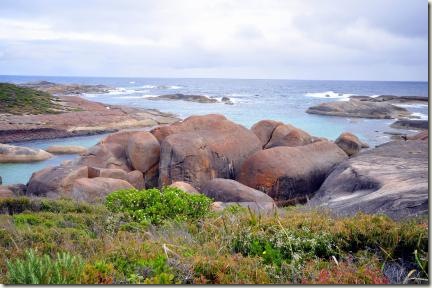
elephant cove Elephant Rock was the next stop which you could only spot from the right  angle. We arrived and had a look atwilliam bay np stranded the beach first. Then my dad and I started to explore the elephants. We had to go around one big rock and down some slope before we were standing before the herd of elephants.

Now it was time to pitch the tent and we drove to a community run camping place close to the beach. We managed to get the spot furthest away from the beach (the beach was our morning exercise) which was nice and quiet. It was allowed to have a camp-fire but we didn’t have any wood nor wanted to buy a complete wheelbarrow so no camp-fire.

tree top walk tree top walk 4The Tree Top Walk was fantastic and one of the places my mum was really keen to see. The walk is approx. 700m long and up to 45m high up  in the trees. Sometimes the pathway swung in the wind! They had some informative signage which explained that the trees survive fires well and just establish a new canopy beneath the old one. We did the walk twice – we had to get the pictures from all angles.

hug the tree Adjacent is the Ancient Empire Forest – several tall and old trees (mainly red and yellow tingle trees). These trees roots don’t grow into the depth they cover a lot of ground so we walked on boardwalks. Sometimes we had to walk through the trees – there was no other way to continue the path.

We had a quick picnic at the Coalmine Beach andswarbrick 2 headed to the Swarbrick Sculpture Walk within the Walpole Nature park. To enter that park you nearly  had to open a dunny-door but luckily it was just standing next to the pathway. But then we came to a mirror which was nearly 20m long and we had to find the gab. To see all sculpture we had to keep our eyes wide open and the head swirling around as they were high up in the trees, on the ground or in the bushes.

swarbrick 3fernhook 2This night we camped at the Fernhook Falls and had the first camp-fire for my parents! The fire was used to re-heat our rissoles. This camp-area is  managed by the DEC and offered several tent/campervan sites plus two huts. Unfortunately I don’t know how the huts look like as they were already occupied when we arrived. We walked to the falls snake gully but not much water was running. I’m not sure if the level should be higher or not. From May/June till October/November you could launch your canoe and paddle downstream… But of course it’s already December we didn’t launch anything.

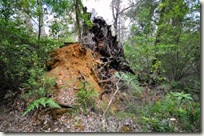
jungle step We continued to drive the tourist drive “Great Forest Tree Drive” and stopped at a little cove. After a little driving experience for my dad we stopped in Northcliffe and walked the Twin-Karri Walk. This tree looked like a Siamese twins – the trunk was connected. On the other side the walk led through Karri and Marri forest. It was a bit like walking in a jungle. If a tree fells down it will not be moved away. They just made a little gab or some steps into the trunk so the crossing was not too difficult.

bibbulmum track There is also the option to walk nearly 1,000km from Perth to Albany. It’s the 8-week adventure track called Bibbulmun Track. Of course we didn’t walk the whole track we just crossed it several time and walked some paths which used the same track.

Always one step after the other,

Keep walking, MaPa, Tom and Anja

P.S. This time the reading is not over… I thought to provide some more pictures for you to have a look at ;-)

driving the good old car 1 driving the good old car 2

driving the good old car 3 jungle root

tall karri ancient forest 2 ancient forest

tree top walk 5 twin karri tree top walk 4

swarbrick 1 kookaburra

tree top walk 3 tree top walk 2

william bay np who is hiding

Saturday, January 8, 2011

6. December

Whale Worldww cheynes4Australia was a whaling nation and many cities hat their own whaling fleet and whaling stations – like Albany. The Southern Right, Humpback and Sperm Whale were hunted and all live in the waters surrounding Albany. The Sperm Whale prefers the deep waters of the Continental Shelf which lies at around 30 nautical miles from Albany. It was not so profitable to hunt Sperm Whale probably one reason it could be hunted longer than theww warning other whales. In 1978 all whaling was forbidden in Australia and several cities lost part of their industry and most whaling stations closed and got demolished. The whaling station in Albany was re-formed into a museum and we had a look at it. The area is quite small but anyway we spent several hours there – there was so much to see, discover, explore and learn.

And our visit begun. First we had a look at the Colin Green Heritage Gallery which shows some photos of the whaling operation as well as displaying some whaling artefactsww early version of engine like flensing boots. Just after 10 minutes it was time to join the tour guide. Most times you get more  information with a tour guide than just visiting on your own. The tour started at the Boiler House where a working triple expansion steam engine is. The engine is still in working conditions as the demonstration showed.

Next stop was the Flensing Deck where the dead whale was towed on deck and the blubber stripped off. The whales were hunted during the day ww whale towingand towed into the bay where they stayed overnight. If the hunt was  successful they would radio in and the Flenser could be contracted for the next day. They started early and had to get the whales onto the deck (beating the lurking sharks). On the deck the real fun started – to stripe the blubber. We listened to an audio broadcasting the atmosphere and noises. I don’t think that to be a Flenser was a sought after job – it was very dangerous and no insurance cover possible at all. They had to climb onto the whale wearing the gum-boots with the spikes and use their ww cookers knifes. Don’t think of a knife for cutting meat or bread it looks more like a golf-club but completely of metal and a sharp cutting edge. They were never able to get the smell of their clothes…

Then we moved to the Cutting-Up Deck. The blubber had to be cut into smaller pieces otherwise it couldn’t be thrown into the cookers. In the cookers the whale is reduced to a liquid and the oil is extracted. They tried to use as much as possible of the whale including the bones. The bones were crushed down. Of course they had to separateww demonstration the head from the body using the head-saw. The extracted oil was stored in the huge oil tanks before it got to the oil tanker. The tanker were filled by a huge pipeline which was checked for leaks before any filling. The oil was too valuable and too much hard work involved to waste any. Of course did the dead whales attract sharks and they would have a feast. But that never lasted long as the sharks were killed then. Any shark bite could tear 1/5 of the bladder so the whaler tried to ‘recover’ it by killing the shark.

We also looked into the engineering and blacksmith workshop which now houses whaling artefacts and other equipment (boats, flensing knifes, flensing boots…). Some pictures are also displayed mostly about the whaling operation and how busy the flensing deck looked like but I preferred the picture of the Giant Squid. The squid was eaten by a Sperm Whale. ww giant squidThe Panorama Tower Gallery was an interesting place. I nearly got lost as it had 4 entrances. The gallery provides an pictorial and graphical insight into the antics of the whalers from 1950 to 1978. The pictures showed several crew members as well as some history about this whaling company. We learnt that they originally only owned one boat but were able to get two of a Queensland company which had to close in 1963ww full speed ahaed when the Humpback Whale came off the hunting list. Later they were able to purchase the fourth vessel. All boats have a different story how they “ended” their life – Cheynes I was destroyed and used as a spare-parts, Cheynes II was sold to a private investor who wanted to establish a restaurant (but nothing happened and the vessel sunk), the Cheynes III is tourist attraction in its own as it’s a diving wreck and Cheynes IV is still at the whaling station included in the exhibits.

Four buildings are used as a movie theatre. One workshop is now housing the Spectravision Theatre which explains the life of a whaler and his family – how the normal day of life was. They also feature how theww skeletton 2 information of the whaling station closure effected the families. The other movie theatres are in the oil storage tanker. One is about the history of Australian Whaling, one about the relation between sharks and whalers and the third is about the whales. It’s called “Giants exist” and is a 3D-movie. I really liked it and of course everyone tried to touch the whales.

ww blue whale jaws Then we went into another “Giant” shed – we had to walk underneath a gigantic skeleton – ok it was only the jaw bones of a blue whale but really big. Inside the building were more skeletons to see. We had a look at a 22m Pygmy Blue Whale (the jaw bones were much smaller). There are more skeletons from whales and dolphins. All animals are found in the waters nearby. A head of a Humpback Whale was on display as well – the “teeth's” were visible – this material was used for corsets.

Our final look took us onto the vessel Cheynes IV. It was possible to walkww harpunists into many rooms except of the engine compartment. We had a look at the different quarters from captain, second mate to standard crew and of course there were lots of differences. And K-Leun was in action again – he spotted a whale and the 1. WO had to hurry down the catwalk to assist the harpunists. Yeah, I know someone has to stay in control of the vessel ;-)

ww giving directions1 ww giving directions 2

Thar she blows,

Ahoi, MaPa, Tom and Anja

ww skeletton 1